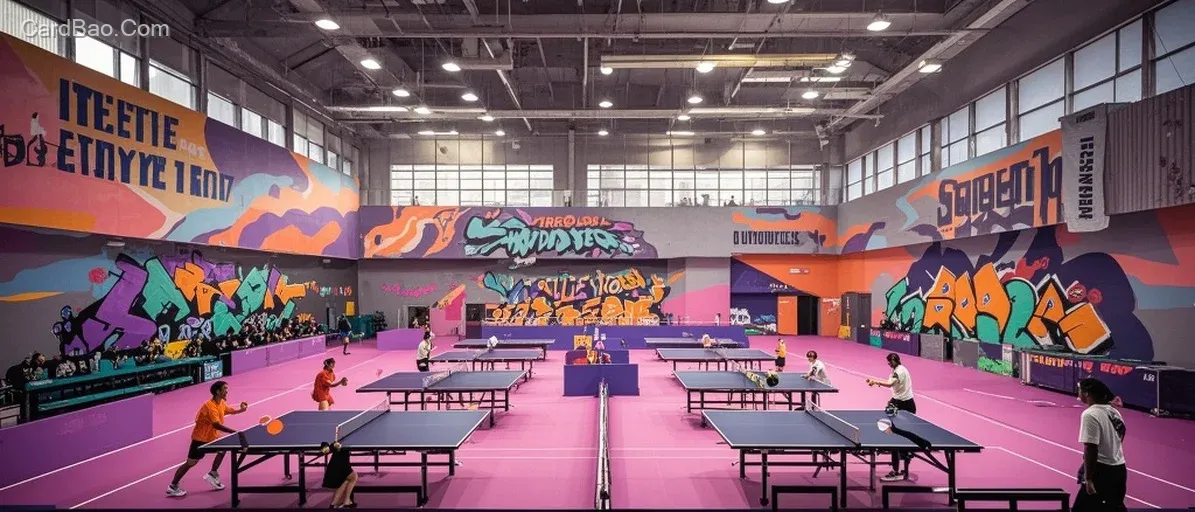
Vibrant Ping Pong Hall: Perfect Harmony of Color and Function
活力乒乓馆:色彩与功能的完美平衡
English Prompt:
Realistic Photography of Table Tennis Venues
Adopt high-saturation colors (such as pink, orange, and purple) to create a vibrant atmosphere that aligns with the dynamic nature of table tennis, while also enhancing spatial recognition. The color combinations are thoughtfully designed—for instance, a purple venue incorporates brand elements to convey cultural associations through color, while an orange-and-gray venue uses linear patterns to break monotony and enrich visual layers.

2. Spatial Layout
The layout centers around the table tennis tables, arranged neatly to ensure ample space for movement while reserving pathways for smooth circulation and convenience. This reflects a balance between functionality and aesthetics.
Some venues (such as those with glass walls or high ceilings) leverage transparent designs and vertical extensions to expand visual boundaries, making the space appear more open.

3. Brand and Cultural Integration
Walls feature the club’s name, slogans, and sports-related patterns (such as table tennis rackets or images of players in action) to strengthen brand identity, convey the spirit of sportsmanship, and imbue the space with cultural depth. Slogans like "Strive for Glory" integrate sports, brand identity, and national pride, enhancing the space’s cultural significance.

4. Lighting Design
Uniform, bright, and evenly distributed lighting (often using long strip lights) meets the functional needs of sports activities. Meanwhile, strategic lighting arrangements (such as pendant lights in purple venues or ambient lighting) enhance the atmosphere and highlight the space’s colors and textures.

Color Strategy: Select a primary color palette based on the space’s function and theme, using high-saturation hues to energize the environment. Complementary colors (lines, patterns) add depth, while small contrasting accents create visual focal points.
Balance of Function and Aesthetics: Prioritize core functionality (sports and usability) with an orderly layout to ensure practicality, then enhance aesthetics through colors and decorations, making the space both functional and visually appealing.
Brand and Cultural Integration: Incorporate brand names, slogans, and relevant patterns on walls and soft furnishings to strengthen recognition and cultural messaging at a low cost, applicable to various commercial and sports spaces.
Lighting Atmosphere: Use basic lighting to meet functional needs, supplemented by ambient lighting (such as pendant lights or LED strips) tailored to the space’s theme. Variations in brightness and color enhance the scene’s appeal. These designs integrate sports functionality, visual beauty, and cultural expression.
中文Prompt:
乒乓球场馆真实摄影
采用高饱和度色彩(如粉色、橙色、紫色 ),打造活力氛围,契合乒乓球运动的动感属性,也增强空间辨识度。色彩搭配有巧思,像紫色场馆结合品牌元素,借色彩传递文化关联;橙灰配色场馆用线条图案打破单调,丰富视觉层次。
2. 空间布局
均以乒乓球桌为核心,规整排列保障运动空间,同时预留通道,兼顾运动流畅性与通行便利性,体现功能与美观的平衡。
部分场馆(如带玻璃墙、挑高空间的 )借通透设计、纵向延伸感,拓展视觉边界,让空间更显开阔。
品牌与文化融入
墙面融入俱乐部名称、标语、运动元素图案(乒乓球拍、人物击球形象 ),强化品牌标识,传递运动精神,赋予空间文化内涵。、“拼搏 荣耀”标语,借体育+品牌+家国情怀的融合,提升空间底蕴。
4. 灯光设计
统一采用明亮、均匀的照明(多为长条灯),保障运动光线需求,同时通过灯光布局(如紫色场馆的吊灯、环境光 ),渲染氛围,突出空间色彩与质感。

 色彩策略:根据空间功能、主题选主色调,用高饱和色激活活力,搭配辅助色(线条、图案)丰富层次,小面积撞色还能制造视觉焦点。
功能与美学平衡:以核心功能(运动、使用)为基础,规整布局保障实用性,再通过色彩、装饰提升美观度,让空间“好用又好看”。
 文化与品牌植入:墙面、软装融入品牌名、标语、相关图案,低成本强化辨识度与文化输出,适用于各类商业、运动空间。
灯光氛围营造:基础照明保障功能性,再用氛围光(如吊灯、环境灯带 )适配空间主题,通过明暗、色彩变化,增强场景感染力。这些设计把运动功能、视觉美感、文化传递结合
Resolution: 1195×512